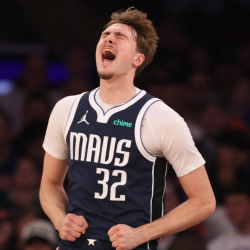
The #1 overall NBA draft pick is often judged against sometimes unrealistic expectations compared to say the #2 and #3 pick, and there’s so many factors that impact the success of that top selection. With those expectations in mind, we think it’s fair to say that Cooper Flagg’s early performances in a Dallas Mavericks jersey have been among the few bright spots in an otherwise uneven season and that impact is even more notable given how inconsistent Jason Kidd’s team has looked as a whole.
Barely 19 years old, Flagg has already delivered on his top-pick billing. Over the past month, he has led Dallas in scoring in 14 games, consistently finishing as one of the team’s most productive players while maintaining efficiency despite heavy defensive attention. During that stretch, he has averaged solid double-figure scoring, contributed on the glass, and remained one of the Mavericks’ most reliable two-way presences.
| Stat | Value |
|---|---|
| Games Played | 16 |
| Games Led Team in Scoring | 14 |
| Points per Game | 19.4 |
| Rebounds per Game | 7.8 |
| Assists per Game | 3.2 |
| Field Goal % | 46.1% |
| On/Off Net Rating | +6.3 |
The Mavericks currently sit at 18–26 in the standings, a record that reflects a campaign defined by injuries and lineup instability. Dallas must now navigate an extended absence for Anthony Davis, sidelined for up to six weeks with a hand injury, placing even more responsibility on its younger core. Without Flagg’s contributions, the Mavericks’ situation could look considerably bleaker.
For fans who believe Flagg’s emergence could still push Dallas toward play-in contention, those expectations are already being reflected in betting markets. Anyone looking to explore that angle can find broader league context and projections at sportsline.com/guides/nba/, which offers updated insights into playoff probabilities, team trajectories and Rookie of the Year odds.

On that, Flagg has emerged as a front-runner for Rookie of the Year, though the race is far from settled. His primary competition comes from a familiar name: former Duke teammate Kon Knueppel, whose scoring efficiency and perimeter shooting have made him one of the league’s most productive rookie guards. While Knueppel has thrived as a high-usage scorer in a more defined offensive role, Flagg’s case is built on versatility impacting both ends of the floor, leading his team in scoring, and shouldering responsibility on a roster fighting through adversity. As the season progresses, the ROY debate is shaping up as a contrast in styles: Knueppel’s polished shot-making versus Flagg’s all-around impact and leadership under pressure.
Jason Kidd, now in his fifth season at the helm, has repeatedly praised Flagg’s maturity and influence. Speaking recently, Kidd emphasized the rookie’s leadership role despite his age:
“We all know he is special, so just understanding that we’ll never take anybody for granted. His skill set, his maturity at the age of 19 — he is leading this team. He is one of our leaders on the floor and off the floor, and we have to lean into that.”
Flagg has been equally measured in responding to the growing attention around his leadership.
“Leader or not, I just try to stay true to myself,” Flagg said. “If that helps the team, then great. For me it’s about being vocal, being myself, and letting that side come out.”
That composure has mattered, particularly as injuries have forced Dallas to rely more heavily on younger players. Flagg briefly exited the Mavericks’ 109–118 loss to the Denver Nuggets with an ankle injury, though early indications suggest the issue may not be serious. Kidd will be hoping to have the teenager available consistently as the season progresses. That steadiness is hardly accidental, as Flagg has long been accustomed to high-level competition, having grown up sharpening his game alongside his twin brother, who has also drawn attention in basketball circles.
Despite this year’s struggles, Kidd’s overall tenure in Dallas has largely been a success. In his first season, he guided the Mavericks to the Western Conference Finals, and two seasons later led them to their first NBA Finals appearance in over a decade, even if both runs ended in five-game series losses.
The 2024–25 season marked a rare losing campaign for the franchise, but it also positioned Dallas to secure the No. 1 pick, a stroke of fortune that delivered Cooper Flagg. If his early performances are any indication, the Mavericks may have landed a foundational talent capable of reshaping the organization’s trajectory for years to come.

 99812
99812